
Top In-Demand Skills & Job Areas in Europe for 2026 — Career Guide
Explore the most in-demand skills and fastest-growing job areas in Europe in 2026, including tech, healthcare, green energy, AI, cybersecurity, logistics, and more. Learn where opportunities are booming and how to future-proof your career.
 Mahfuz Hosen
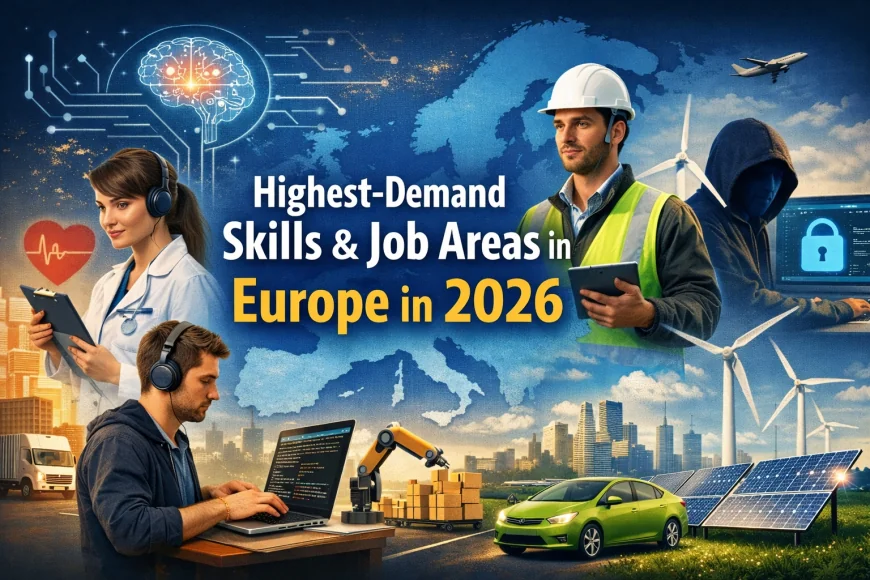
Europe’s job market is evolving rapidly as technological advances, demographic shifts, economic transformations, and sustainability goals reshape demand for talent. Whether you’re a recent graduate, mid-career professional, or someone considering relocation or reskilling, understanding which skills and occupations Europe will need most in 2026 will help you make strategic career decisions.
In this comprehensive guide, we break down emerging job markets, key skills employers are seeking, sector-specific demands, and future growth areas across Europe. We also highlight long-term trends and offer actionable advice to boost your employability.
1. The Big Picture: Europe’s Labor Market Trends for 2026
Europe’s labour market continues to experience a tight job vacancy rate, low unemployment, and skills shortages in key professions. The net result? Many employers are struggling to find qualified workers even as new roles emerge in growing industries like digital technology, sustainability, and health services.
Meanwhile, some industries are transforming due to automation and AI, reducing demand for certain traditional roles while creating opportunities in more sophisticated areas of work.
Below are the most significant job market trends shaping Europe’s employment landscape in 2026:
-
Digital transformation and AI adoption driving demand for technology skills.
-
Green economy initiatives as Europe pushes toward net-zero emissions.
-
Healthcare and aging populations creating sustained need for care professionals.
-
Supply chain and logistics expansion due to e-commerce growth.
-
Continued demand for traditional trade and craft skills in construction and utilities.
2. Tech & Digital Roles: The Heart of Europe’s Future Job Market
Technology remains at the core of employment growth in Europe, but the range of roles is widening far beyond basic coding jobs. In 2026, jobs that combine business understanding, digital literacy, analytical thinking, and technical fluency are especially prized.
A. Software Development & Engineering
Software developers and engineers continue to top the list of most advertised roles. Companies across industries—from finance to manufacturing—are seeking talent to build, maintain, and upgrade software systems. Roles include:
-
Full-stack developers
-
Backend engineers
-
Frontend engineers
-
Cloud solutions architects
-
Mobile app developers
Software development typically requires proficiency in languages like Python, JavaScript, C#, and Java, as well as frameworks such as React, Node.js, and .NET.
Why it matters: Software developers remain foundational to digital transformation across sectors.
B. Artificial Intelligence & Machine Learning
AI and machine learning skills are rapidly transitioning from niche to mainstream—especially in areas where companies use data to optimise operations and innovate new products.
In Europe, demand is growing for professionals who can:
-
Develop machine learning models
-
Deploy AI systems responsibly
-
Analyse large datasets
-
Integrate generative AI technologies (e.g., GenAI tools)
-
Design AI governance frameworks
Key job titles include: AI Engineer, Machine Learning Researcher, Data Scientist, GenAI Specialist.
Aligning with broader European strategies around digital competitiveness, AI roles are critical to future economic growth.
C. Cybersecurity & Data Protection
Cybersecurity has never been more critical. As companies digitise operations, the risk of cyberattacks increases, driving demand for security professionals who can protect infrastructure and sensitive data.
In 2026, sought-after cybersecurity skills include:
-
Threat analysis and incident response
-
Ethical hacking and penetration testing
-
Security architecture design
-
Regulatory compliance (GDPR expertise)
Shortages of skilled security professionals remain acute—a trend continuing into 2026 as risk awareness grows.
D. Data Science & Analytics
Data professionals are needed everywhere, from marketing teams to government agencies. Employers want people who can transform raw data into actionable insights that drive decisions.
Core competencies include:
-
SQL and Python
-
Data visualization
-
Statistical analysis
-
Business intelligence tools
Managing and interpreting complex datasets is one of the most transferable job skills in today’s economy.
3. Healthcare: Sustained Demand in a Growing Sector
Europe’s aging population and the expansion of health services guarantee long-term demand for healthcare professionals. According to job posting data and public sector analyses, roles in healthcare consistently rank among the most advertised.
A. Nursing & Care
Nurses, caregivers, and allied health professionals are in high demand across European countries, especially where populations are aging rapidly. Specific roles include:
-
Registered nurses
-
Gerontological care specialists
-
Rehabilitation therapists
-
Medical support staff
B. Medical Technicians & Specialists
Beyond traditional caregiver roles, specialised technicians such as radiology technicians, laboratory analysts, and medical device operators are essential to modern healthcare delivery.
C. Telehealth & Digital Health Specialists
The rise of telemedicine has created jobs that bridge healthcare and technology. These roles require combined knowledge of healthcare practices and digital systems—skills that will only grow more important.
4. Green Economy & Sustainability: A Fast-Growing Field
Europe has set ambitious climate targets, such as achieving net-zero emissions by 2050. This has triggered investments in renewable energy, energy efficiency, carbon reduction, ecological design, and sustainable infrastructure.
A. Renewable Energy
Jobs in wind, solar, and other renewable sectors are expanding rapidly. Green energy roles include:
-
Renewable energy engineers
-
Solar panel technicians
-
Wind turbine installers
-
Grid integration specialists
These occupations combine technical skills with specialised environmental knowledge.
B. Sustainability & ESG Roles
Environmental, Social, and Governance (ESG) roles focus on measuring and improving company sustainability performance. Examples include:
-
Sustainability consultants
-
Climate risk analysts
-
Corporate ESG strategists
Such professionals help organisations comply with regulations and communicate sustainability achievements to stakeholders.
C. Green Construction & Retrofitting
Green building has become a priority as Europe seeks to retrofit old buildings for better energy performance, driving demand for green construction specialists and architects familiar with energy-efficient design.
5. Logistics, Supply Chain & E-Commerce Jobs
E-commerce has transformed supply chain needs across Europe, creating numerous opportunities in logistics, warehousing, and transportation.
A. Supply Chain Managers & Analysts
These professionals are responsible for ensuring products move from producers to customers efficiently. Skills in optimisation, forecasting, inventory control, and digital logistics tools are essential.
B. Warehouse Operators & Fulfilment Specialists
With global giants and local firms ramping up delivery operations, there’s strong demand for skilled warehouse professionals who can operate robotics, manage logistics software, and handle goods efficiently.
C. Transport & Heavy Vehicle Drivers
Despite automation trends, Europe continues to face shortages in professional drivers for freight and logistics operations.
6. Finance, FinTech & Regulatory Roles
While some traditional finance roles are shrinking due to automation and AI optimisation, niche opportunities are rising in digital banking, compliance, risk management, and fintech innovation.
EU countries are investing in digital financial services, blockchain tech, and digital identity systems. Demand includes:
-
Digital banking product managers
-
Risk and compliance experts
-
Blockchain and crypto compliance analysts
These roles sit at the intersection of finance, regulation, and technology.
7. Professional Services & Management
Despite a heavy focus on tech and green roles, management and business functions remain central to Europe’s job market. According to recent labour data, roles such as team leaders, project managers, and sales directors still represent a significant share of job postings.
A. Project & Product Management
Professionals who can coordinate cross-functional teams and deliver projects on time and on budget are in perennial demand—especially in tech, construction, and consultancy sectors.
B. Sales & Business Development
Sales professionals with digital fluency and consultative skills are valuable across industries, from tech to healthcare.
8. Emerging & Specialized Fields to Watch
In addition to the major categories above, some cutting-edge sectors are beginning to demand talent in Europe:
A. Quantum Technologies
While still early-stage, quantum computing and related industries are growing in Europe, with increasing demand for engineers and researchers who understand quantum theory and hardware.
B. Augmented Reality (AR) & Virtual Reality (VR)
These immersive tech fields require hybrid technical and creative skills, ranging from UI/UX design to 3D graphics programming.
C. AI Ethics & Governance
As AI adoption spreads, Europe’s regulators and firms alike are focused on responsible AI use, creating demand for expertise around governance, compliance, and ethical frameworks.
9. Soft Skills That Employers Value in 2026
While technical skills are crucial, employers increasingly look for transferrable soft skills, such as:
-
Adaptability and flexibility
-
Collaborative teamwork
-
Critical thinking and problem-solving
-
Communication and interpersonal skills
-
Willingness to learn continuously
In fact, willingness to learn and collaboration are among the most listed soft skills in European job ads.
10. Tips for Job Seekers and Career Changers
Whether you’re entering the workforce or pivoting careers, here are practical tips:
-
Upskill with online courses: Platforms like Coursera, Udacity, and LinkedIn Learning offer AI, cybersecurity, and data courses.
-
Obtain recognised certifications: Certifications from AWS, Google Cloud, PMI, and ISC2 can boost your credibility.
-
Learn languages: In multi-lingual Europe, knowing English plus another EU language (e.g., German, French, Spanish) can be a major advantage.
-
Build a portfolio: For digital roles, a strong portfolio can sometimes outweigh formal education.
-
Stay informed: Labour market data and job boards (e.g., LinkedIn Jobs, Indeed, EuroBrussels) offer insights into evolving demand.
Conclusion: Europe’s Job Market in 2026
Europe is entering a phase where skills, adaptability, and lifelong learning will shape careers more than ever before. From artificial intelligence to healthcare to renewable energy, industries across the continent are clamouring for talent.
If you want to future-proof your career for 2026 and beyond, focus on a blend of technical expertise, sector knowledge, and soft skills. With the right preparation and strategic positioning, professionals can tap into a dynamic, growing job market with opportunities across Europe.